
How Innovative Are Our Organisations Today?
Innovation Maturity in Practice
During our Innovation in Learning MOOC, we asked participants a simple but revealing question:
How innovative is your organisation today?
Our community placed a pin on a innovation maturity scale to explore where innovation currently sits in their organisations. The scale ranges from: Beginner, where innovation relies mostly on individual effort; Traditional, where it sits in central units; Scaling, where more teams start to build capability; and Advanced, where innovation is more coordinated across the organisation.
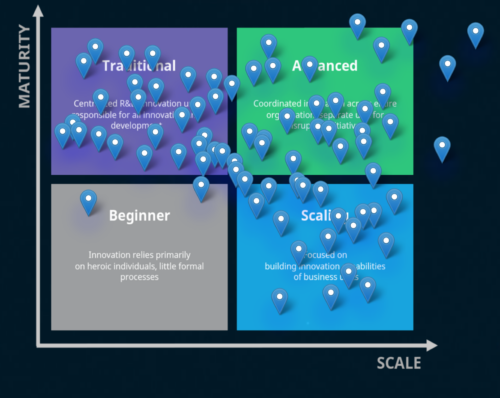
The results, and the conversations that followed, offered a clear and honest picture of how innovation currently lives inside organisations.
1. There is movement, but it is not yet everywhere
Very few participants saw themselves at the early stages. Most organisations are experimenting, trying new approaches, or building momentum in some form. Curiosity is present, and people are looking for ways to improve how they work.
At the same time, most placements landed between Traditional and Scaling. Innovation is happening, but often within specific teams or projects rather than across the whole organisation. Many described their organisation as being “in transition” and working to move from isolated initiatives to something more connected and better supported.
2. Much of innovation relies on motivated individuals
A theme that came up repeatedly was how often innovation depends on people who take initiative simply because they believe in it. Participants described situations many of us recognise:
- ideas appear but lack a clear route forward
- teams want to explore, but daily demands dominate
- progress depends more on enthusiasm than on structure
Individual drive can spark great things, but when it is the only driver, it becomes difficult to scale or sustain.
3. Innovation maturity differs across the same organisation
Another strong insight was how uneven innovation can be within a single organisation. Some teams feel free to try new approaches, while others work within environments shaped by regulation, compliance, or a need for stability. Larger organisations, especially, showed pockets of highly innovative practice alongside more traditional ways of working.
This variation is normal, but it often goes unnoticed. Seeing it visualised helped participants acknowledge these differences and consider what different teams might need in order to progress.
4. Culture makes the difference
Although tools and methods were part of the MOOC, participants kept returning to culture as the real differentiator. They spoke about psychological safety, leaders who show curiosity, the value of reflection, and the importance of shared direction.
When these elements are present, innovation grows more naturally. When they are missing, even strong ideas struggle to take hold.
Several participants also noted that a strong learning culture does not automatically create a strong innovation culture. Learning fuels curiosity, but without structure and sponsorship, innovation remains scattered.
5. Honest reflection is a sign of maturity
One of the most encouraging outcomes was the realism in how people placed themselves on the scale. Few claimed to be fully advanced. Many acknowledged gaps between ambition and practice, or differences in maturity across teams.
This openness matters.
Innovation begins with understanding where things truly stand.
For L&D professionals, these insights point clearly toward the work ahead: supporting leaders to model experimentation, embedding learning more deeply in daily routines, and building systems that help ideas grow beyond small pilots.