
Social Learning in Action: Learning Together and Transforming Organizations
At a time when knowledge and skills are aging faster than ever, it is crucial that organizations not only commit to traditional training, but also to sharing knowledge and experiences between employees. Social learning plays a key role here. Incorporating informal learning into daily practice creates a dynamic learning environment that benefits everyone.
What is social learning and for whom is it appropriate?
Social learning is all about the collaborative acquisition and sharing of knowledge through interaction and collaboration. It happens both in formal training sessions and in everyday conversations, on digital platforms or during spontaneous learning moments. This approach is widely applicable: from small teams to large organizations. L&D practitioners in particular see it as a valuable addition because it bridges the gap between theory and practice. When employees share experiences and insights, it creates a common knowledge base that strengthens the entire team and contributes to responding to change faster and more effectively.
Roles within a MOOC
In a MOOC (Massive Open Online Course), participants can take on different roles. Active participants stimulate the learning environment by asking questions, sharing their opinions and coaching each other. This creates a lively dynamic in which new ideas quickly blossom. On the other hand, there are silent participants who take the course in silence and absorb the content. Although their contribution is less visible, their learning form also plays an important role in creating a diverse and inclusive learning environment. The challenge of L&D practitioners is to support both groups and provide an environment where everyone can grow in their own way.
Dealing with different levels of involvement
Not every participant is comfortable with active participation. While some groups thrive on interactive discussions, others take a more individual approach. This difference in engagement does not mean that silent participants learn less. Nevertheless, a lack of interaction can reduce joint synergy. It is therefore important to provide a mix of learning opportunities: interactive sessions combined with opportunities for independent learning. This gives everyone a chance to contribute and benefit from shared knowledge, while creating a safe and open environment where mistakes are allowed and learning is natural.
Measuring the effectiveness of social learning
To understand the impact of social learning, it is essential to have clear metrics. Some key KPIs include:
- Knowledge flow: How fluidly and quickly is knowledge shared within the organization? Are new insights widely applied?
- Degree of knowledge sharing: How often do discussions and feedback sessions take place? How actively are questions asked and answers shared?
- Quality of interactions: Are the exchanges valuable and lead to concrete improvements in the way we work?
By regularly evaluating these indicators, L&D practitioners get a clear picture of what is working and where adjustments can be made.
Best practices from practice
A number of leading organizations have already successfully deployed social learning and are happy to share their experiences:
- Capgemini: At Capgemini, this approach is an essential part of professional development. By deploying our interactive platform StreamLXP and peer-to-peer coaching, Capgemini fosters a culture of continuous improvement and knowledge sharing among their clients. This results in faster problem solving and promotes innovation at a variety of clients.
- Ikea: Time and again, Ikea has created a stimulating learning environment where employees can learn through both structured and informal moments. Using our interactive platform StreamLXP not only increases productivity and efficiency, but also strengthens employee engagement and collaboration.
- Ministry of Education, Culture and Science (OCW): This ministry uses this learning method to share knowledge and best practices widely within MBO 2030, so that educators can benefit optimally from each other's experiences. The result is a dynamic platform where innovative ideas are quickly transformed into policy and practice.
Interventions for maximum impact
To fully harness the power of social learning, organizations can employ a variety of interventions:
- Organize interactive sessions: Schedule regular discussion groups, brainstorming sessions and feedback rounds to actively engage employees.
- Create an open learning environment: Encourage a culture where making mistakes is allowed and where learning from experience is natural.
- Use modern technology: Implement user-friendly digital platforms such as StreamLXP to facilitate knowledge sharing.
- Engage in peer-to-peer coaching: Encourage employees to support and coach each other, which not only promotes collaboration but also accelerates professional growth.
Conclusion
Social learning offers a powerful method for keeping organizations flexible and innovative. Through a combination of active and individual learning methods, clear metrics, and targeted interventions, organizations can reap the benefits of a shared knowledge base. Best practices from Capgemini, Ikea, and the Dutch ministries show that a culture of collaboration and continuous knowledge sharing leads to faster problem solving, more engaged employees, and an overall strengthening of the organization.
Want to transform your organization and leverage social learning to its full potential? Then contact Next Learning Valley. Together we take the first step towards a future where knowledge sharing is the engine of growth and innovation. Discover the possibilities and start your transformation today!
Wondering how your organization can harness the power of social learning?
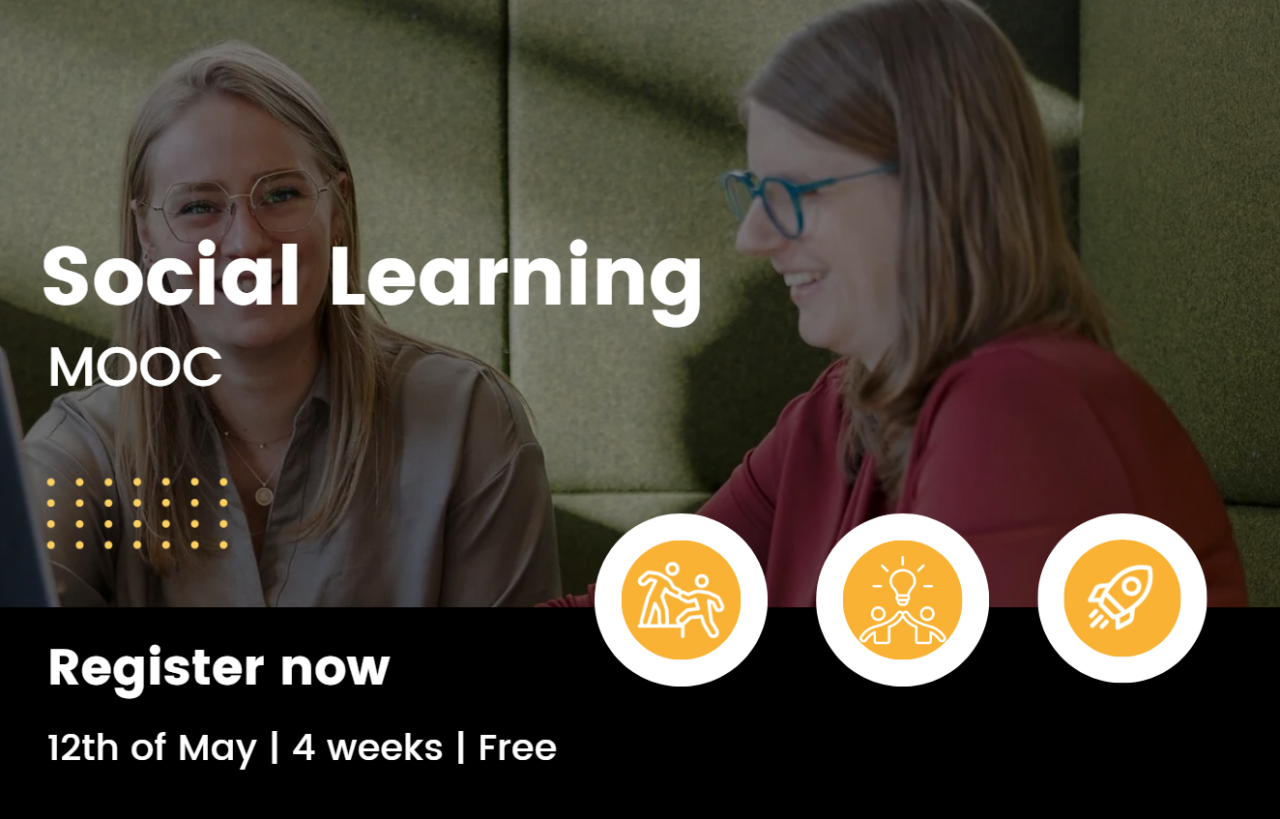 Join our MOOC Social Learning(free) - a four-week online course packed with practical insights, inspiring cases and smart tools. Discover how to strengthen knowledge sharing, foster a learning culture and break knowledge silos.
The MOOC is flexible, fully online and designed specifically for L&D professionals and changemakers in organizations.
👉 Subscribe now