
Award Winner: Blended Learning Meets Real-World Simulation
How do you ensure that professionals are well-prepared to act even in high-pressure situations? By building knowledge in advance, practicing skills in a realistic and safe environment, and then applying those skills on the job. That exact approach is at the heart of “Blended Learning Meets Real-World Simulation, ” the project by RadarVertige and Next Learning Valley.
Together with RadarVertige, we won a bronze award for this case at the 2026 Learning Technologies Awards, in the Best Use of Blended Learning – Public & Non-Profit Sector category.
The Challenge: Turning Knowledge into Action
Law enforcement officers and other public sector professionals encounter situations in which tension or aggression can escalate quickly. Knowledge of protocols is important in such situations, but it is not enough: professionals must recognize warning signs, make decisions, and respond appropriately.
Role-playing in a conference room can only partially simulate the tension of a home visit or confrontation. On-site training is more realistic, but it presents practical challenges. Participants may be filmed or provoked, training sessions are weather-dependent, and the cost per participant is high.
At the same time, clients wanted a better understanding of the benefits of training. RadarVertige saw that the approach was effective, but was not yet able to properly substantiate participants’ progress with data. There was a need for a learning pathway that combines realistic and safe practice with insight into what participants learn and apply in their work.
From Learning Data to Targeted Training
Aksel de Leeuw, an L&D consultant at Next Learning Valley, turned the question “Can we do anything with that data?” into a concrete approach. Together with RadarVertige, he investigated which learning activities could be made measurable, what information was needed to do so, and how that information could be put to use in dashboards.
This gives trainers insight into their group’s learning objectives and responses in advance. They can tailor the hands-on training to what participants still need to practice and devote more time to application, feedback, and reflection. Participants also gain insight into their performance and progress.
The Four-Step Learning Path
The blended learning approach combines e-learning, hands-on training, and on-the-job learning:
- Preparation through e-learning. Participants complete short modules at their own pace. An initial assessment evaluates, among other things, their knowledge, self-confidence, and ability to recognize emotions and aggression. Participants set learning goals and bring real-life situations to the training.
- Understanding the group through learning data. Trainers review answers and learning objectives in advance via a dashboard. This allows them to tailor the training to the group’s needs.
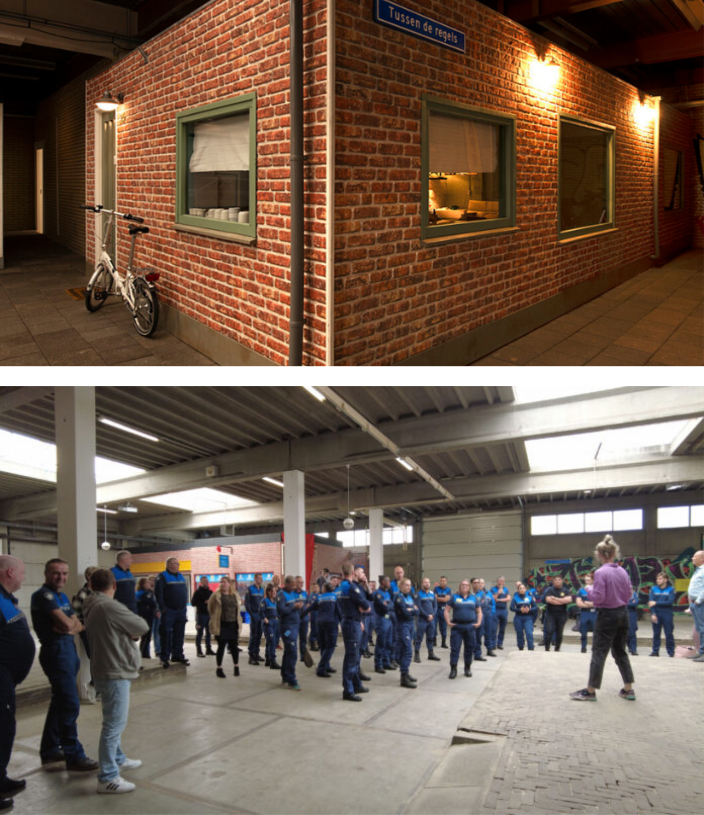
- Practicing skills in the RadarLAB. Participants practice in a realistic, controlled environment with scenarios that mirror their work. Because the theory has already been covered online, there is more time during the training for practical application, feedback, and reflection.
- Applying what you’ve learned in the workplace. After the training, participants complete a practical assignment related to their daily work. The trainer provides feedback, and another assessment is conducted three to six months later.
The training thus forms a learning pathway that combines preparation, hands-on training, and application in the workplace.
What do the results show?
The results reveal three key insights:
- Participants feel better prepared to handle stressful or aggressive situations. Their average self-assessment score rose from 3.12 at the start to 4.00 immediately after the training and to 4.05 after three to six months, on a scale of 1 to 5. The assessment points included 73, 13, and 12 participants, respectively.
- Participants find the course material applicable to their daily work. The evaluation summary shows an average rating of 8.65 out of 10. The applicability of the content scores 8.72; knowing which actions help apply what was learned and the relevance to daily work both score 8.51.
- The guidance provided during the training is highly rated. The trainer’s ability to connect with the group scored 8.98, the interaction between the trainer, the actor, and the group scored 9.03, the motivation to engage with the topic scored 9.01, and the usefulness of the feedback scored 8.95.
The evaluation summary includes data from 9,474 participants and 4,881 evaluations. The self-assessments and evaluations paint a positive picture of the participants’ perceived development and the relevance of the training to their work. The study groups varied by assessment time point, and there was no control group.
What does this mean for participants and their work environment?
This approach helps participants better prepare for situations involving tension or aggression. They build their knowledge, practice safely in realistic, real-world scenarios, and receive feedback they can apply in their work. This gives them a stronger foundation when they need to recognize warning signs and make decisions in real-life situations.
The work environment also benefits: trainers tailor exercises to the group’s needs, and participants can immediately apply what they’ve learned in their daily work. This ensures that the training is better aligned with the situations professionals actually face.
Technology provides support. It’s the real-world application that makes the difference.
Daniel van der Stam of RadarVertige puts it aptly:
“That’s exactly what I love about my job. Technology and data should support (practical) learning.”
With “Blended Learning Meets Real-World Simulation,” RadarVertige and Next Learning Valley combine preparation, hands-on training, feedback, and on-the-job learning. We are incredibly proud of this partnership and of the bronze award we won together.

Previously honored with a Learning Technologies Award
Read about how ABN AMRO and Next Learning Valley previously won a Learning Technologies Award.